Sourced narrative
Each block is a verifiable statement. The number opens the cited page; amber or coral blocks flag tradition or contested interpretation.
11 statements
01Evidence and context
In France, antisemitic traditions arose from both the clerical right and the anticapitalist left.
Charles Fourier cast Jews as symbols of predatory commerce and rejected their emancipation.
Pierre-Joseph Proudhon combined anticapitalism, religious hostility, and exterminatory language.
Alphonse Toussenel depicted Jewish financiers as a new economic nobility.
Édouard Drumont's Jewish France (La France juive) became a major antisemitic publishing success.
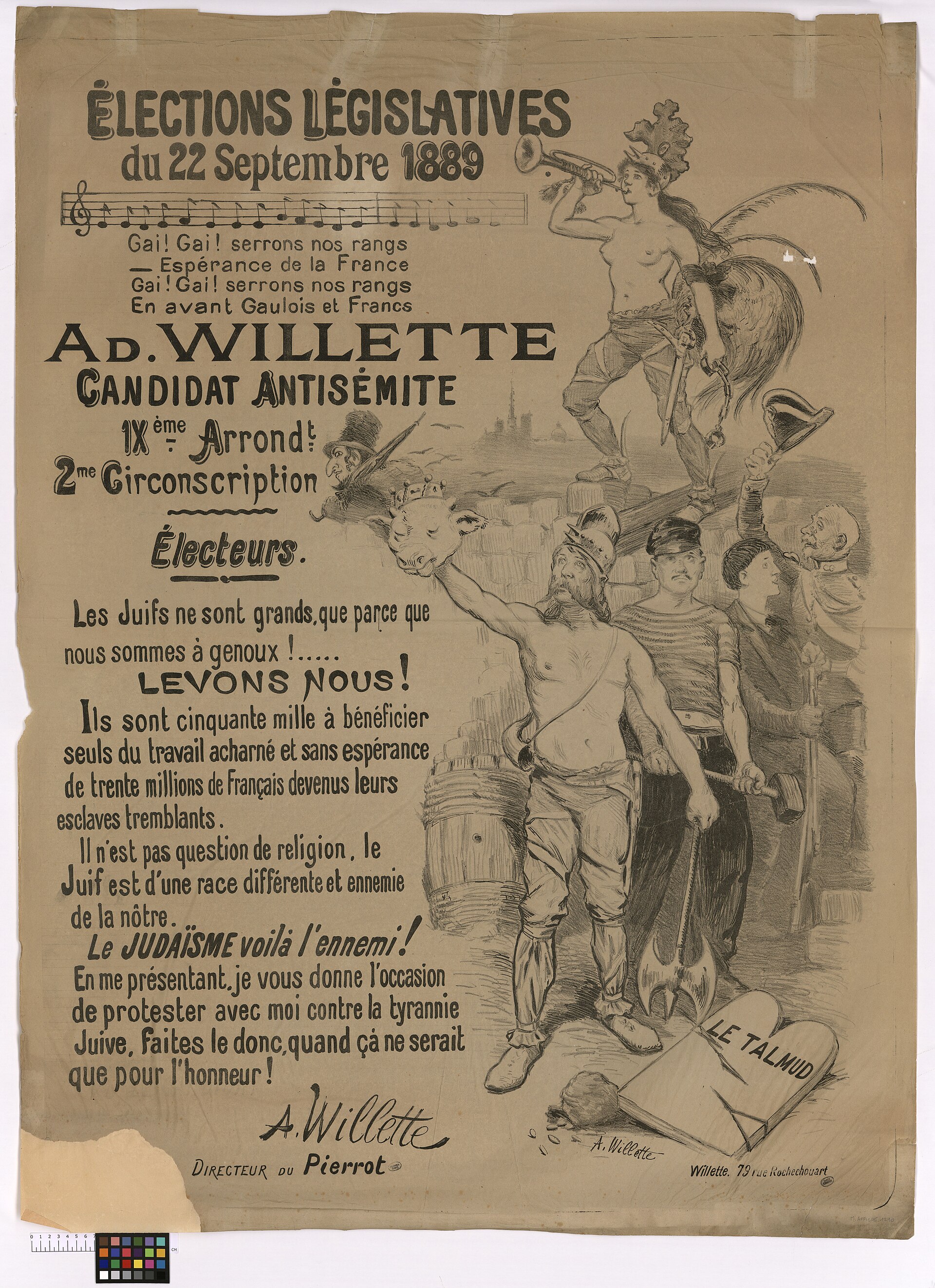
In 1889 Adolphe Willette campaigned for a Paris legislative seat on an antisemitic platform.
In 1894, Alfred Dreyfus was falsely accused of espionage through forged documents.
Dreyfus was publicly degraded and sentenced to life on Devil's Island.
In 1898, Emile Zola denounced the military cover-up in J'accuse.
Dreyfus received a pardon in 1899 and full exoneration only in 1906.
The Dreyfus Affair tested the Republic and helped bring separation of church and state.
Context
Pierre-Joseph Proudhon combined anticapitalism, religious hostility, and exterminatory language.
Alphonse Toussenel depicted Jewish financiers as a new economic nobility.
Édouard Drumont's Jewish France (La France juive) became a major antisemitic publishing success.
§ 01Geography
Where it happened
§ 02Museum
Objects and images

§ 03Historiography
What scholars debate
Scholarly debate · 01
What was at stake in the Dreyfus Affair?
2 positions · no single answer · take a seat →
- A
Alleged Jewish treason
Anti-Dreyfusards
The conviction was presented as proof of collective disloyalty.
- B
Defense of the Republic
Dreyfusards
Dreyfus was an innocent victim of a conservative conspiracy.
§ 04Network
Connections
§ 05Bibliography
Further reading
Shmuel Almog, Nationalism & Antisemitism in Europe, 1815-1945 (New York: Pergamon Press, 1990).
Nationalism and antisemitism · recommended in Efron, Lehmann and Weitzman, p. 376
§ 06Apparatus
Sources on this page
- 01Efron, Lehmann and Weitzman, p. 348inspect
- 02Efron, Lehmann and Weitzman, p. 347inspect
- 03Efron, Lehmann and Weitzman, p. 346inspect
- 04Efron, Lehmann and Weitzman, p. 346inspect
- 05Efron, Lehmann and Weitzman, p. 347inspect
- 06Efron, Lehmann and Weitzman, p. 347inspect
- 07Efron, Lehmann and Weitzman, p. 347inspect
- 08Efron, Lehmann and Weitzman, p. 349inspect
- 09Efron, Lehmann and Weitzman, p. 347inspect
- 10Efron, Lehmann and Weitzman, p. 348inspect
- 11Efron, Lehmann and Weitzman, p. 348inspect
- Documented evidenceAttested by contemporary evidence: texts, inscriptions, coins, papyri or archaeology.
- Scholarly reconstructionHistorians' inference from indirect evidence.
- Tradition or narrativeA literary, traditional or religious account; significant in itself, but not independently verified.
- Contested interpretationScholars explicitly disagree; see the positions in the debate.
- Illustrative reconstructionA hypothesis or visual scheme to guide reading; not a historical claim.